
High-Performance Wires and Conductors for Electricity Transmission

Powering Nepal's Hydropower Revolution: High-Performance Wires and Conductors for Zero-Loss Transmission
Nepal is experiencing an unprecedented boom in clean energy generation. With hundreds of megawatts being unlocked across major river basins, the nation’s focal challenge has shifted from generation to transmission. Evacuating raw power from remote, rugged mountain terrains to the central pool of the National Grid requires cutting-edge engineering.
At Janaki Cable, a top-tier pioneer in cable manufacturing in Nepal, we specialize in manufacturing heavy-duty heavy-machinery conductors engineered explicitly for zero-loss national infrastructure. As the nation transitions its energy framework, our specialized cable and wiring products stand as the most reliable bridge between rural hydropower hubs and urban substations.
Why Wires and Conductors Matter for Nepal’s Hydropower Projects ?
In a typical Nepalese hydropower project, power must travel through deep gorges, face harsh sub-zero temperatures, survive heavy seasonal monsoons, and span massive structural distances. Substandard cabling under these extreme physical loads results in major mechanical sagging and severe electrical transmission drops.
For commercial IPPs (Independent Power Producers) and the Nepal Electricity Authority (NEA) grid expansions, minimizing line losses directly protects corporate and public revenue. That is why choosing specialized, high-tensile overhead lines is critical to handling power evacuation reliably without system tripping.
The Core Elements of Nepal’s Power Evacuation Grid
As shown in the imag below, three foundational wiring architectures dictate the modern distribution grid:
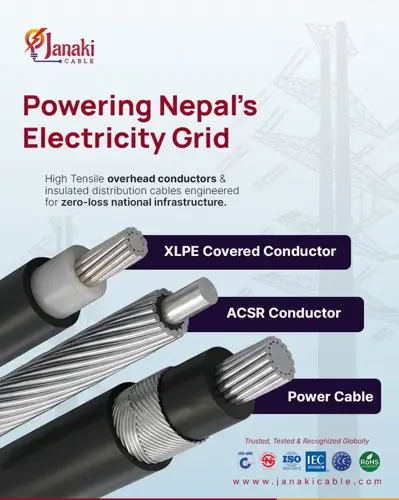
1. XLPE Covered Conductors
Traditional open wires are prone to immediate short-circuiting when coming into contact with dense forest canopies. Our XLPE Covered Conductors utilize cross-linked polyethylene insulation. They offer high heat resistance, high mechanical resilience, and safeguard high-voltage corridors moving across forested or rural terrains.
2. ACSR Conductors (Aluminium Conductor Steel Reinforced)
The global standard for high-voltage transmission over long spans. ACSR Conductors couple the electrical performance of outer aluminum strands with a highly rigid steel core. This design withstands structural tension when crossing deep valleys or wide river beds typical of hydropower geographies.
3. Power Cables (Insulated Underground & Industrial Cables)
Perfect for primary and secondary distribution lines, urban grids, and industrial plants, Power Cables feature robustly insulated and sheathed conductors. They virtually eliminate power theft, maximize public safety by containing high voltages underground or within conduits, and prevent environmental hazards like spark fires and weather-induced outages.
4. Advanced Power Transmission Alternatives
For specialized grid sections requiring maximum immunity to oxidation and moisture, we offer AAAC conductors constructed from advanced heat-treated aluminum alloys. These provide exceptional structural durability with lighter weight components. Additionally, our industrial-grade power cables and LV power cables provide heavy-duty underground distribution alternatives perfect for indoor power houses and switchyard networks.
Engineered Under Strict Global and Local Benchmarks
Quality infrastructure cannot rely on guesswork. Every single batch running through the Janaki Cable facility in Dhanusha adheres strictly to ISO 9001:2015, CE, IEC, and RoHS compliance frameworks.
We test our lines extensively for tensile limits and maximum conductivity thresholds in-house. This provides peace of mind to consultants, grid contractors, and project managers across Nepal's power sector.
Frequently Asked Questions (FAQs)
What makes Janaki Cable conductors suitable for hydropower transmission lines in Nepal?
Our conductors are explicitly engineered for high-tensile environments, meaning they handle the immense mechanical and thermal strains of mountainous spans while optimizing electrical transfer to ensure near zero-loss performance over long distribution arcs.
What is the main difference between ACSR and AAAC conductors?
ACSR conductors use a high-strength inner steel core to hold heavy loads across immense spans. AAAC conductors are completely constructed using a premium aluminum alloy, making them significantly lighter and highly resistant to galvanic oxidation in highly humid zones.
Can Janaki Cable accommodate custom specifications for bulk energy projects?
Yes, our manufacturing lines handle direct scaling for commercial infrastructure projects. Technical developers can view our updated cable and wire price list or reach out directly to coordinate precise cross-sections and structural lengths.
About The Author
Love Mishra
As the Quality Control Incharge at Janaki Cable Industry Limited, I bring over 9 years of experience in quality assurance, quality control, and manufacturing processes within the cable industry. Learn more about me...